Eggshell Calcium as a Source of Calcium for Bone Health: Scientific Evidence and Clinical Studies

Calcium is an essential mineral for maintaining normal bones and plays a fundamental role in bone metabolism. While calcium is available from a variety of dietary and supplemental sources, eggshells have attracted scientific interest as a natural source of calcium. Experimental and clinical research has investigated the bioavailability of eggshell calcium and its potential relevance to bone health (Rovenský et al., 2003).

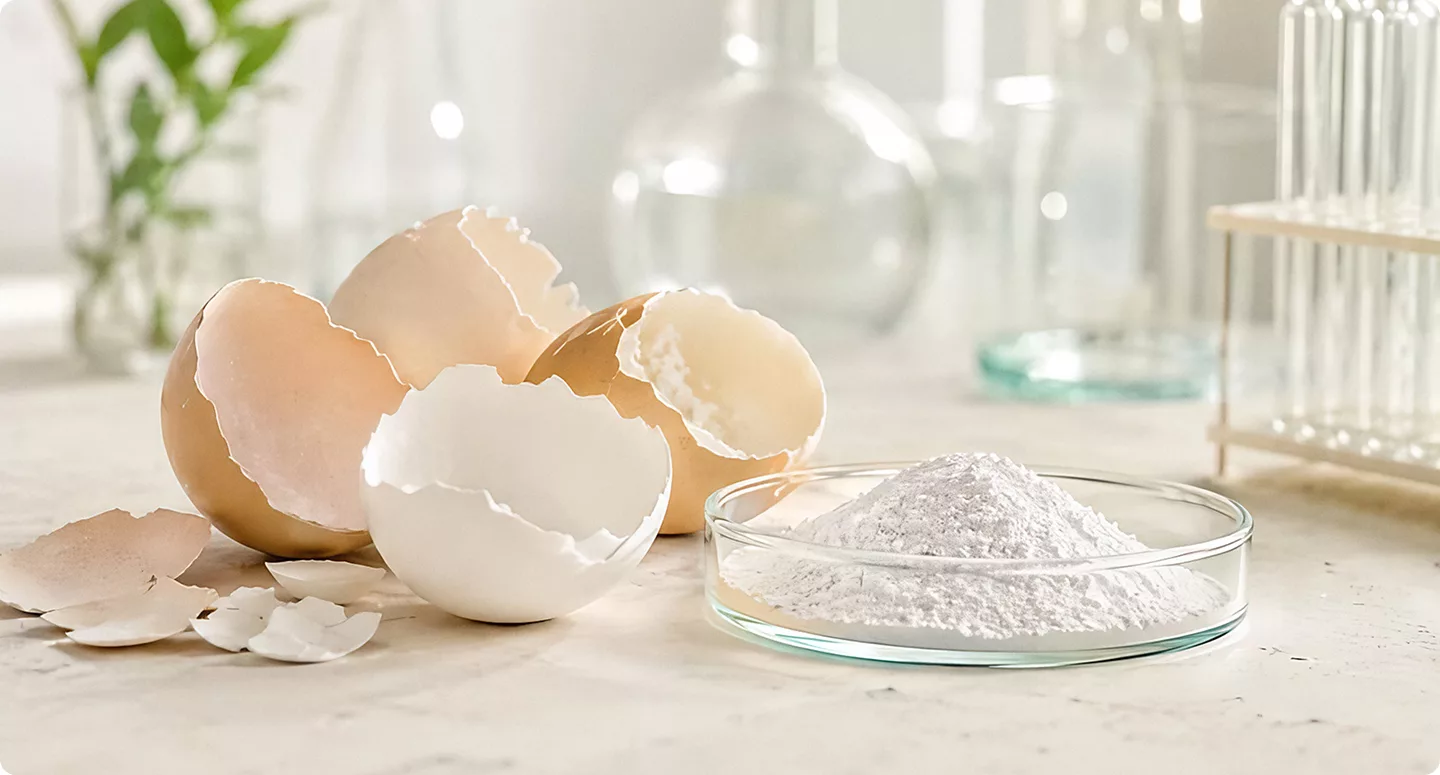
Eggshells consist predominantly of calcium carbonate and are being investigated as a natural source of calcium.

The role of calcium in bone health

Bone is a dynamic tissue that is continuously remodeled throughout life. Old bone tissue is broken down while new bone is formed. Calcium is an essential component of this process and contributes to the maintenance of normal bones.

Bone mass may gradually decline with age. In women, the menopausal transition is associated with significant changes in bone metabolism, partly due to declining estrogen levels. Adequate calcium and vitamin D intake, together with regular physical activity, are important factors in maintaining bone health (Sakai et al., 2017).

In addition to conventional calcium compounds, researchers have therefore investigated calcium derived from natural sources. One such source is eggshell calcium.

Eggshells as a natural calcium source

Eggshells consist predominantly of calcium carbonate and also contain small amounts of other minerals and trace elements. In 2003, Rovenský and colleagues published a scientific review summarizing experimental and clinical research on eggshell powder. The review examined, among other aspects, calcium bioavailability and potential effects on bone, cartilage and bone metabolism (Rovenský et al., 2003).

The studies reviewed suggested that eggshell powder may provide a readily available source of calcium. Research examining calcium availability indicated that calcium derived from eggshells may be comparable to, and in some studies more readily available than, calcium from purified calcium carbonate (Rovenský et al., 2003).

It is important to interpret these findings in the context of the available evidence. The publication by Rovenský et al. is a review of several experimental and clinical investigations rather than a single clinical trial. Consequently, it should not be regarded as definitive evidence that eggshell calcium prevents or treats osteoporosis (Rovenský et al., 2003).

Evidence from clinical research

A particularly relevant study was published in 2017 by Sakai and colleagues. This randomized controlled study investigated the effects of eggshell calcium supplementation on bone mass in 54 postmenopausal women (Sakai et al., 2017).

The participants were divided into three groups of 18 women each. One group received 300 mg of calcium from eggshells per day, a second group received 300 mg of calcium from calcium carbonate, and a control group received no additional calcium supplementation (Sakai et al., 2017).

The intervention lasted for twelve months. Bone mass was assessed at baseline and after six and twelve months. The researchers used the Speed of Sound (SOS) measurement as a parameter related to bone status (Sakai et al., 2017).

54Participants
3 × 18Study groups
300 mgCalcium daily
12 monthsStudy duration

Study Findings

After twelve months, the eggshell calcium group showed a statistically significant increase in the measured SOS value. The increase was also significantly greater than that observed in both the calcium carbonate and control groups. No statistically significant difference was observed between the calcium carbonate group and the control group (Sakai et al., 2017).

Based on these findings, the authors concluded that eggshell calcium was more effective than calcium carbonate in increasing the measured bone mass parameter in the postmenopausal women included in the study (Sakai et al., 2017).

Eierschalen-Calcium powder
What Do These Findings Mean for Bone Health?

Study findings in context

The available research suggests that eggshell calcium may be an interesting source of calcium in the context of bone health. The review by Rovenský et al. summarized several studies reporting favorable calcium availability and potential effects on different parameters associated with bone health (Rovenský et al., 2003).

The findings of Sakai et al. provide additional clinical data from a controlled study involving postmenopausal women. In that study, twelve months of eggshell calcium supplementation was associated with a significant improvement in the measured bone mass parameter (Sakai et al., 2017).

Nevertheless, the current evidence should be interpreted with appropriate caution. Larger and longer-term clinical studies would be required to establish the long-term effects of eggshell calcium on bone health and, in particular, to determine whether supplementation has an effect on clinically relevant outcomes such as fracture risk (Rovenský et al., 2003; Sakai et al., 2017).

Eggshell calcium and vitamin D

Calcium is not the only nutrient relevant to bone health. Vitamin D also plays an important role in calcium absorption and utilization. For this reason, eggshell powder has also been investigated in combination with vitamin D in more recent research.

A randomized, double-blind, controlled study published in 2024 investigated 25 postmenopausal women between 50 and 64 years of age. Over a period of six months, participants received either a meal fortified with eggshell powder and vitamin D or a comparable meal without these additional nutrients (Joo et al., 2024).

However, the observed effect cannot be attributed to eggshell calcium alone, as vitamin D was administered simultaneously. The study should therefore be interpreted as evidence regarding the combined intervention rather than as evidence of the isolated effect of eggshell calcium (Joo et al., 2024).

However, the observed effect cannot be attributed to eggshell calcium alone, as vitamin D was administered simultaneously. The study should therefore be interpreted as evidence regarding the combined intervention rather than as evidence of the isolated effect of eggshell calcium (Joo et al., 2024).

Why the source is of interest

Eggshell calcium combines a natural source of calcium with a high calcium content. Existing research indicates that calcium derived from eggshells can have good bioavailability. Experimental and clinical studies have also reported potentially relevant effects on parameters associated with bone health (Rovenský et al., 2003; Sakai et al., 2017).

From a nutritional perspective, maintaining an adequate calcium intake is important for bone health. Calcium contributes to the maintenance of normal bones and is therefore an essential component of a balanced diet.

Conclusion

Eggshell calcium is a scientifically investigated natural source of calcium. A review published in 2003 summarized experimental and clinical research indicating that calcium from eggshells may have good bioavailability and that eggshell powder may have potentially beneficial effects on certain parameters related to bone and cartilage health (Rovenský et al., 2003).

Further clinical evidence comes from a randomized controlled study published in 2017. In this study, daily supplementation with 300 mg of calcium from eggshells for twelve months was associated with a significant improvement in the measured bone mass parameter among postmenopausal women. The improvement was greater than that observed with a comparable calcium carbonate supplementation (Sakai et al., 2017).

Overall, the available evidence identifies eggshell calcium as an interesting natural source of calcium with potential relevance to bone health. However, the current evidence should be interpreted cautiously. Existing studies do not establish that eggshell calcium prevents or treats osteoporosis, and further large-scale, long-term clinical research is needed to assess its effects on clinically relevant outcomes such as fracture risk (Rovenský et al., 2003; Sakai et al., 2017).

Food supplements can complement a balanced diet but should not be considered a substitute for a balanced diet, medical assessment or medical treatment of an existing condition.

Scientific references

Rovenský, J., Stancíková, M., Masaryk, P., Svík, K., & Istok, R. (2003). Eggshell calcium in the prevention and treatment of osteoporosis. International Journal of Clinical Pharmacology Research, 23(2–3), 83–92. PMID: 15018022.

Sakai, S., Hien, V. T. T., Tuyen, L. D., Duc, H. A., Masuda, Y., & Yamamoto, S. (2017). Effects of Eggshell Calcium Supplementation on Bone Mass in Postmenopausal Vietnamese Women. Journal of Nutritional Science and Vitaminology, 63(2), 120–124. DOI: 10.3177/jnsv.63.120.

Joo, N. S., Shin, S. H., Kim, K. N., Lee, S. H., Jung, S., & Yeum, K. J. (2024). Home Meal Replacement Fortified with Eggshell Powder and Vitamin D Prevents Bone Loss in Postmenopausal Women: A Randomized, Double-Blind, Controlled Study. Nutrients, 16(8), 1152. PMID: 38674843.